
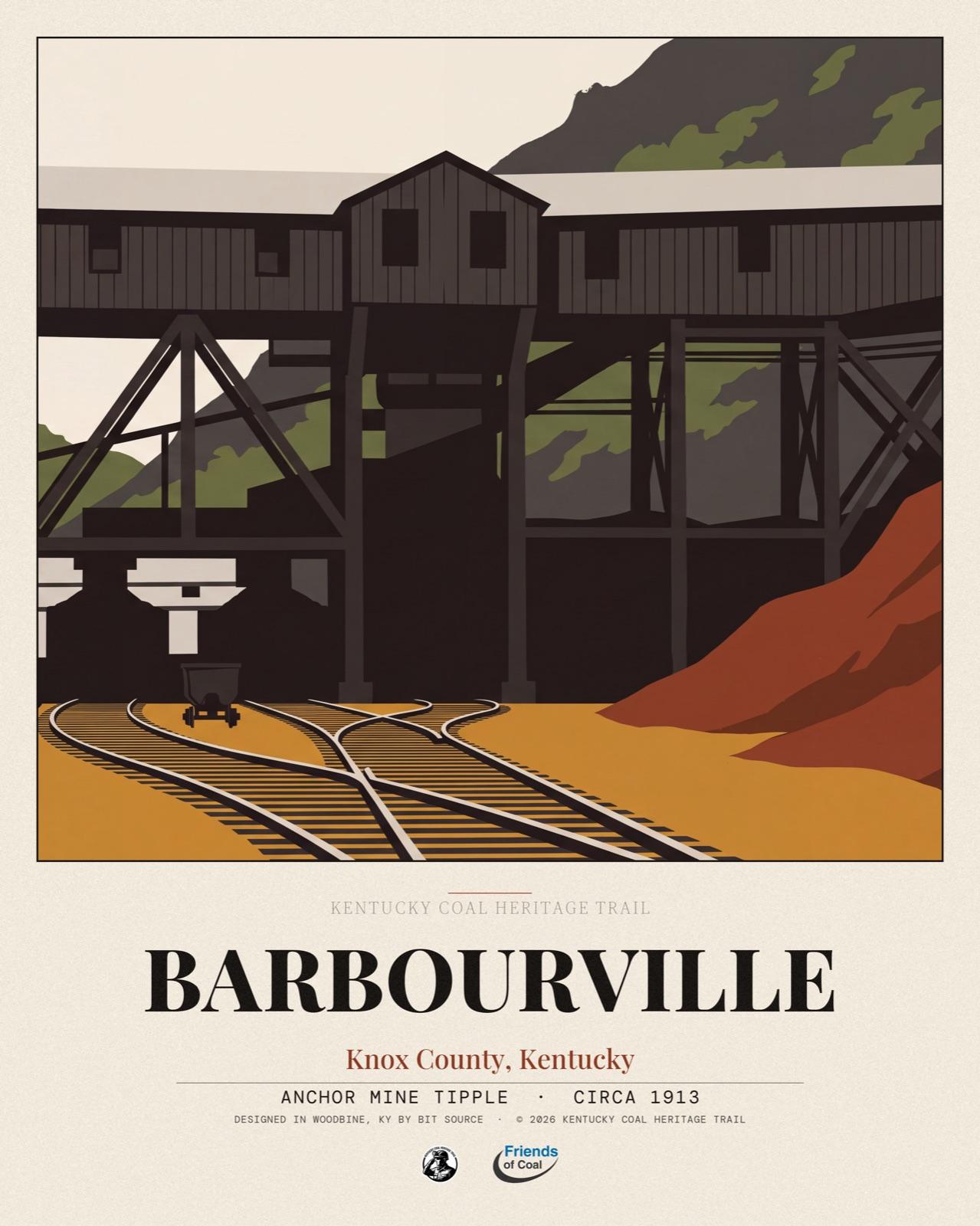
Welcome to Barbourville
Barbourville is the county seat of Knox County.
In 1750, explorer Dr. Thomas Walker visited the area, preceding Daniel Boone by 17 years. While there, he built what is believed to be the first cabin in Kentucky. In 1775, the first trails and roads were created, such as The Wilderness Road, Warriors Path and the Daniel Boone Trail known as the Boone Trace.
In 1800, the town of Barbourville was established, making it the oldest town and the largest and most progressive city south of Richmond. In 1879, the first college in the mountains, Union College, was established.
Barbourville is presently an agricultural trading center for tobacco, timber, vegetables, and sorghum.
The Namesake
The name Barbourville was adopted for the community formerly known as Hammonsburg in honor of James Barbour, who was the Governor of Virginia at the time and donated land for the town.
The Mines
Compiled from Dodrill's 10,000 Coal Company Stores
Company Name
Producing Years
Number of Employees
Bastin Coal Company
1905-1906
50
Consumers Co-Operating Coal Company
1923-1925
35
K D Blue Gem Coal Company
1919-1923
30
Richland Creek Coal Company
1919-1925
20
Turkey Creek Coal Company
1923-1930
55
Important Places
Union College
Union College is a private, four-year liberal arts institution affiliated with the United Methodist Church. Founded in 1879, it is one of the oldest universities in Kentucky. Union College offers a range of undergraduate and graduate programs and contributes to the educational and cultural landscape of Barboursville and Knox County.
Daniel Boone National Forest
Surrounding Barbourville, Daniel Boone National Forest is a national forest in Kentucky. Established in 1937, it includes 708,000 acres of federally owned land within a 2,100,000-acre proclamation boundary.
Dr. Thomas Walker State Park
This state park is located southeast of Barbourville and contains the Dr. Thomas Walker State Historic Site, the home of the first house built by settlers in Kentucky. Today, the park contains a replica of the cabin that was constructed by explorer and physician Dr. Thomas Walker. The state park is located on Ky. 459 off U.S. 25E. On June 20, 1931, the Dr. Thomas Walker State Shrine became a part of Kentucky Parks.
Notable People
After becoming a member of the Loyal Land Company, Dr Thomas Walker organized the first known English expedition through Cumberland Gap on April 13, 1750. He named the gap through the mountains after the Duke of Cumberland, the son of King George II. The Walker expedition, under the auspices of the Loyal Land Company, came to Kentucky to explore and lay claim to 800,000 acres of wilderness. On April 23, 1750, the explorers encountered a river that Walker also named the Cumberland. After exploring the surrounding countryside, Walker built a small, crude cabin to give legality to the lands he had claimed. He stayed in the area for a few days and started the journey homeward. On July 13, 1750, he returned to Virginia. He did not return to Kentucky, but he did leave a journal containing an account of his exploration to eastern Kentucky. Among the accounts of the difficulties and hardships in traveling through the wilderness, Walker noted that during the journey his party had killed 13 buffalo, 8 elks, 53 bears, 20 deer, 4 wild geese, and about 150 turkeys, besides small game. He recorded that the expedition could have “killed three times as much meat, if we had wanted it.”
George Madison Adams was born in Barbourville. After attending Centre College to study law, but failing to graduate, Adams served as the Knox County Circuit Clerk from 1859-1861. He was then elected as a Democrat to the 40th and to three succeeding Congresses from March 4, 1867, to March 3, 1875 (the 41st, 42nd and 43rd Congresses). He was an unsuccessful candidate for reelection in 1874 to the 44th Congress. He was then elected Clerk of the House of Representatives on December 6, 1875, during the 44th Congress, and served until the commencement of the 47th Congress on December 5, 1881. Adams was later appointed register of the Kentucky Land Office by Governor J. Proctor Knott, serving from 1884 to 1887. He was then appointed secretary of state for Kentucky by Governor Simon B. Buckner and served from 1887 to 1891. Following his tenure as Secretary of State, Adams was appointed Kentucky State railroad commissioner in 1891. Lastly, Adams was appointed United States pension agent at Louisville by President Grover Cleveland and served from 1894 to 1898.
James D. Black was born on Richland Creek, 9 miles from Barbourville. Black served as the 39th Kentucky governor for 7 months following his election as Lieutenant Governor with Governor Augustus O. Stanley. Stanley resigned from the Governorship when he was elected to the US Senate, thus elevating Black to Governor. Prior to his political career, Black graduated from Tusculum College and opened his law practice in 1874. He served as superintendent in the Knox County Public Schools for two years and was instrumental in the founding of Union College, serving as its president from 1910-1912.
James S. Golden was a U.S. Representative born in Barbourville. Golden had a notable career both in law and politics. After completing his education, which included a law degree from the University of Michigan, Golden began practicing law in his hometown in 1916. He quickly became involved in public service, serving as the county attorney for Knox County from 1918 to 1922. Golden was elected to the U.S. House of Representatives as a Republican, representing Kentucky's 9th district from 1949 to 1955. Following the elimination of that district, he represented the 8th district from 1953 to 1955. During his time in Congress, he was known for his dedication to his constituents, although he did not seek re-election in 1954. After leaving Congress, Golden returned to practicing law until his death on September 6, 1971, in Pineville, Kentucky.
John M. Robsion Jr. was a U.S. Representative who served from 1953 to 1959. Born in Barbourville on August 28, 1904 Robsion was the son of John M. Robsion Sr., who also served as a U.S. Representative and a U.S. Senator from Kentucky. Robsion Jr. followed in his father's political footsteps, beginning his career in law after earning a degree from Cumberland School of Law in 1927. His entry into politics was marked by his election to the U.S. House of Representatives as a Republican in 1952. He represented Kentucky's 9th congressional district from 1953 until 1955, and after the district was eliminated, he represented the 7th district from 1955 until 1959. During his time in Congress, Robsion was known for his work on issues related to veterans' affairs and agricultural policy. He chose not to seek re-election in 1958 and returned to practicing law.
William A. Stanfill was a U.S. Senator who served a brief term from November 19, 1945, to January 3, 1947. Born on January 16, 1892, in Barbourville, Stanfill pursued a career in law after earning his degree from Union College and the University of Kentucky College of Law. Stanfill's term in the Senate came after the death of Senator Happy Chandler, who had resigned to become Commissioner of Major League Baseball. Kentucky Governor Simeon Willis appointed Stanfill to fill the vacancy. Stanfill was a member of the Republican Party and served during the final months of World War II and the early post-war period. However, his time in office was short as he did not run for election in 1946. After his term ended, Stanfill returned to his legal practice. He remained active in the Kentucky legal and political community until his death on June 12, 1971
Kenneth H. Tuggle served as the Lieutenant Governor of Kentucky from 1943 to 1947. Born on February 12, 1904, in Barbourville, Tuggle was a prominent lawyer and politician in the state. He earned his law degree from the University of Kentucky College of Law and began his legal practice in his hometown. Tuggle's political career gained momentum when he was elected as the Lieutenant Governor under Governor Simeon Willis. During his tenure, Tuggle was known for his efforts to support the state’s economic development and his work on public policy issues. His role as Lieutenant Governor positioned him as a key figure in Kentucky's Republican Party during the 1940s. After serving as Lieutenant Governor, Tuggle continued his public service by working as a member of the Interstate Commerce Commission, where he contributed to the regulation of transportation industries in the United States. He held this position until his retirement in 1971.
Notable Events:
Battle of Barbourville
The city of Barbourville is recognized as the site of the first Civil War skirmish in Eastern Kentucky. On September 19, 1861, Confederate troops launched a surprise attack on the Union camp at Barbourville. The Union forces, though outnumbered, engaged in a brief skirmish before retreating. The Confederates captured the town, as well as supplies and equipment left behind by the Union forces. However, this victory was only temporary, as the region remained contested throughout the war. While not a large battle, the Battle of Barbourville was significant as it marked the beginning of larger conflicts in Kentucky, a border state with divided loyalties. The battle demonstrated the strategic importance of the region and foreshadowed the intense fighting that would occur in Kentucky later in the war.
Daniel Boone Festival
The Daniel Boone Festival is the oldest continuous celebration in the state honoring the man who embodied the pioneer spirit of Kentucky, Daniel Boone. The festival was made a Kentucky Corporation with the intent to ensure that no other community could claim the idea which annually brings thousands of visitors and participants into the city of Barbourville, providing a tremendous economic boost to the area. The festival was created in 1948 by Union College professor Karl Bleyl as a deliberate attempt to challenge mass media’s demeaning images of Kentuckians by replacing negative stereotypes with an heroic model of frontier adventure. Dr. Bleyl hoped that the festival would educate young people about their ancestors’ crossing of the Cumberland Gap into an untamed beautiful land and about the Native American tribes who were there before them.
Audio transcript
THE TOWN OF: BARBOURVILLE, KNOX COUNTY, KENTUCKY

Welcome to Barbourville
Barbourville is the county seat of Knox County.
In 1750, explorer Dr. Thomas Walker visited the area, preceding Daniel Boone by 17
years. While there, he built what is believed to be the first cabin in Kentucky. In 1775,
the first trails and roads were created, such as The Wilderness Road, Warriors Path and
the Daniel Boone Trail known as the Boone Trace.
In 1800, the town of Barbourville was established, making it the oldest town and the
largest and most progressive city south of Richmond. In 1879, the first college in the
mountains, Union College, was established.
Barbourville is presently an agricultural trading center for tobacco, timber, vegetables,
and sorghum.

The Namesake
The name Barbourville was adopted for the community formerly known as
Hammonsburg in honor of James Barbour, who was the Governor of Virginia at the time
and donated land for the town.

The Mines
                 Compiled from Dodrill's 10,000 Coal Company Stores

                                                                     Number of
        Company Name                        Producing Years
                                                                     Employees

        Bastin Coal Company                              1905-1906              50

        Consumers Co-Operating Coal
                                                         1923-1925              35
        Company

        K D Blue Gem Coal Company                        1919-1923              30

        Richland Creek Coal Company                      1919-1925              20

        Turkey Creek Coal Company                        1923-1930              55

Important Places

Union College

Union College is a private, four-year liberal arts institution affiliated with the United
Methodist Church. Founded in 1879, it is one of the oldest universities in Kentucky.
Union College offers a range of undergraduate and graduate programs and contributes
to the educational and cultural landscape of Barboursville and Knox County.

Daniel Boone National Forest

Surrounding Barbourville, Daniel Boone National Forest is a national forest in Kentucky.
Established in 1937, it includes 708,000 acres of federally owned land within a
2,100,000-acre proclamation boundary.

Dr. Thomas Walker State Park
This state park is located southeast of Barbourville and contains the Dr. Thomas Walker
State Historic Site, the home of the first house built by settlers in Kentucky. Today, the
park contains a replica of the cabin that was constructed by explorer and physician Dr.
Thomas Walker. The state park is located on Ky. 459 off U.S. 25E. On June 20, 1931,
the Dr. Thomas Walker State Shrine became a part of Kentucky Parks.

Notable People
After becoming a member of the Loyal Land Company, Dr Thomas Walker organized
the first known English expedition through Cumberland Gap on April 13, 1750. He
named the gap through the mountains after the Duke of Cumberland, the son of King
George II. The Walker expedition, under the auspices of the Loyal Land Company,
came to Kentucky to explore and lay claim to 800,000 acres of wilderness. On April 23,
1750, the explorers encountered a river that Walker also named the Cumberland. After
exploring the surrounding countryside, Walker built a small, crude cabin to give legality
to the lands he had claimed. He stayed in the area for a few days and started the
journey homeward. On July 13, 1750, he returned to Virginia. He did not return to
Kentucky, but he did leave a journal containing an account of his exploration to eastern
Kentucky. Among the accounts of the difficulties and hardships in traveling through the
wilderness, Walker noted that during the journey his party had killed 13 buffalo, 8 elks,
53 bears, 20 deer, 4 wild geese, and about 150 turkeys, besides small game. He
recorded that the expedition could have “killed three times as much meat, if we had
wanted it.”

George Madison Adams was born in Barbourville. After attending Centre College to
study law, but failing to graduate, Adams served as the Knox County Circuit Clerk from
1859-1861. He was then elected as a Democrat to the 40th and to three succeeding
Congresses from March 4, 1867, to March 3, 1875 (the

41st, 42nd and 43rd Congresses). He was an unsuccessful candidate for reelection in
1874 to the 44th Congress. He was then elected Clerk of the House of
Representatives on December 6, 1875, during the 44th Congress, and served until the
commencement of the 47th Congress on December 5, 1881. Adams was later
appointed register of the Kentucky Land Office by Governor J. Proctor Knott, serving
from 1884 to 1887. He was then appointed secretary of state for Kentucky by
Governor Simon B. Buckner and served from 1887 to 1891. Following his tenure as
Secretary of State, Adams was appointed Kentucky State railroad commissioner in
1891. Lastly, Adams was appointed United States pension agent at Louisville by
President Grover Cleveland and served from 1894 to 1898.

James D. Black was born on Richland Creek, 9 miles from Barbourville. Black served
as the 39th Kentucky governor for 7 months following his election as Lieutenant
Governor with Governor Augustus O. Stanley. Stanley resigned from the Governorship
when he was elected to the US Senate, thus elevating Black to Governor. Prior to his
political career, Black graduated from Tusculum College and opened his law practice in
1874. He served as superintendent in the Knox County Public Schools for two years
and was instrumental in the founding of Union College, serving as its president from
1910-1912.

James S. Golden was a U.S. Representative born in Barbourville. Golden had a
notable career both in law and politics. After completing his education, which included a
law degree from the University of Michigan, Golden began practicing law in his
hometown in 1916. He quickly became involved in public service, serving as the county
attorney for Knox County from 1918 to 1922. Golden was elected to the U.S. House of
Representatives as a Republican, representing Kentucky's 9th district from 1949 to
1955. Following the elimination of that district, he represented the 8th district from 1953
to 1955. During his time in Congress, he was known for his dedication to his
constituents, although he did not seek re-election in 1954. After leaving Congress,
Golden returned to practicing law until his death on September 6, 1971, in Pineville,
Kentucky.
John M. Robsion Jr. was a U.S. Representative who served from 1953 to 1959. Born
in Barbourville on August 28, 1904 Robsion was the son of John M. Robsion Sr., who
also served as a U.S. Representative and a U.S. Senator from Kentucky. Robsion Jr.
followed in his father's political footsteps, beginning his career in law after earning a
degree from Cumberland School of Law in 1927. His entry into politics was marked by
his election to the U.S. House of Representatives as a Republican in 1952. He
represented Kentucky's 9th congressional district from 1953 until 1955, and after the
district was eliminated, he represented the 7th district from 1955 until 1959. During his
time in Congress, Robsion was known for his work on issues related to veterans' affairs
and agricultural policy. He chose not to seek re-election in 1958 and returned to
practicing law.

William A. Stanfill was a U.S. Senator who served a brief term from November 19,
1945, to January 3, 1947. Born on January 16, 1892, in Barbourville, Stanfill pursued a
career in law after earning his degree from Union College and the University of
Kentucky College of Law. Stanfill's term in the Senate came after the death of Senator
Happy Chandler, who had resigned to become Commissioner of Major League
Baseball. Kentucky Governor Simeon Willis appointed Stanfill to fill the vacancy. Stanfill
was a member of the Republican Party and served during the final months of World War
II and the early post-war period. However, his time in office was short as he did not run
for election in 1946. After his term ended, Stanfill returned to his legal practice. He
remained active in the Kentucky legal and political community until his death on June
12, 1971
Kenneth H. Tuggle served as the Lieutenant Governor of Kentucky from 1943 to 1947.
Born on February 12, 1904, in Barbourville, Tuggle was a prominent lawyer and
politician in the state. He earned his law degree from the University of Kentucky College
of Law and began his legal practice in his hometown. Tuggle's political career gained
momentum when he was elected as the Lieutenant Governor under Governor Simeon
Willis. During his tenure, Tuggle was known for his efforts to support the state’s
economic development and his work on public policy issues. His role as Lieutenant
Governor positioned him as a key figure in Kentucky's Republican Party during the
1940s. After serving as Lieutenant Governor, Tuggle continued his public service by
working as a member of the Interstate Commerce Commission, where he contributed to
the regulation of transportation industries in the United States. He held this position until
his retirement in 1971.

Notable Events:

Battle of Barbourville
The city of Barbourville is recognized as the site of the first Civil War skirmish in Eastern
Kentucky. On September 19, 1861, Confederate troops launched a surprise attack on
the Union camp at Barbourville. The Union forces, though outnumbered, engaged in a
brief skirmish before retreating. The Confederates captured the town, as well as
supplies and equipment left behind by the Union forces. However, this victory was only
temporary, as the region remained contested throughout the war. While not a large
battle, the Battle of Barbourville was significant as it marked the beginning of larger
conflicts in Kentucky, a border state with divided loyalties. The battle demonstrated the
strategic importance of the region and foreshadowed the intense fighting that would
occur in Kentucky later in the war.
Daniel Boone Festival
The Daniel Boone Festival is the oldest continuous celebration in the state honoring the
man who embodied the pioneer spirit of Kentucky, Daniel Boone. The festival was made

a Kentucky Corporation with the intent to ensure that no other community could claim
the idea which annually brings thousands of visitors and participants into the city of
Barbourville, providing a tremendous economic boost to the area. The festival was
created in 1948 by Union College professor Karl Bleyl as a deliberate attempt to
challenge mass media’s demeaning images of Kentuckians by replacing negative
stereotypes with an heroic model of frontier adventure. Dr. Bleyl hoped that the festival
would educate young people about their ancestors’ crossing of the Cumberland Gap
into an untamed beautiful land and about the Native American tribes who were there
before them.