Welcome to Barthell and Stearns
The Namesakes
Barthell was named after E.E. Barthell, a lawyer from Nashville who drew up the Stearns Coal and Lumber Company's articles of incorporation in 1902 and who served as the company’s general counsel. Barthell died in 1937.
Stearns was named after Stearns Coal & Lumber Company, who built the town.
The Mines
Both Barthell Coal Company and Stearns Coal and Lumber Company operated in the area.
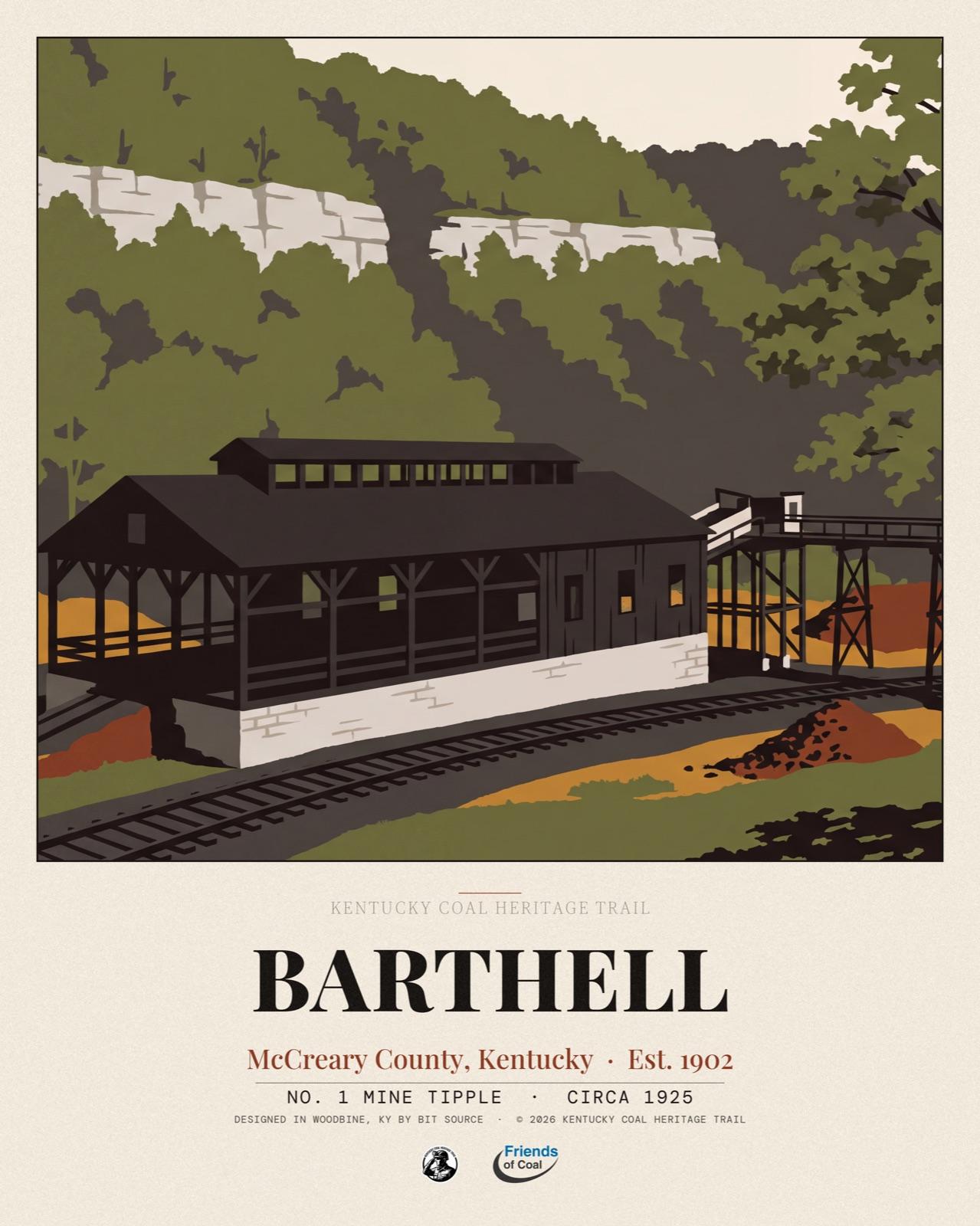
By 1909, Barthell consisted of 41 dwellings, company "Store Number Two" (there were a total of 18), a big motor house, bath house, tipple, school and a post office. Fifteen one- and two-bedroom houses, the bathhouse, barbershop and doctor's office have been meticulously restored and stocked with period antiques. The Stearns Co. also negotiated a contract with Southern Railway, which provided a major market for Barthell’s No. 2 seam coal.
In 1920 the State Bank of Stearns was formed with deposits exceeding $500,000 by 1929. This bank dissolved in 1940-41.
The phasing out of mules working underground began in 1928-29 with Camargo Co. selling electric motors to Stearns.
In January 1930, 100,961 tons of coal was produced at Barthell, which was a record month.
In 1937, Stearns sold much of the already logged property to the US Forest Service, which is now known as the Cumberland National Forest.
In 1943, the tipple and nearby structures burned and were not rebuilt. This was the end of mining at Mine One.
In 1961, the mine and coal camp properties were dismantled, and in 1974 the Big South Fork National Recreation Area was formed.
In 1984, the Koger family purchased Barthell from Stearns Coal & Lumber Company with the intent of creating a tourism attraction. Harold Koger, Harold Dwight Koger and their spouses invested more than half a million dollars to reconstruct the facilities, even obtaining 5 tram locomotives!
Important Places
Both the communities of Barthell and Stearns are now part of the Big South Fork National River and Recreation Area, preserving some of the historical aspects of their coal mining heritage.
The McCreary County Museum is housed in the old Stearns Coal and Lumber Company Corporate headquarters, built in 1907. The Museum was founded in 1988 and is filled with historic documents, objects, and photographs pertaining to Historic Stearns and McCreary County, including exhibits that demonstrate the culture and lifestyle of McCreary Countians over the years. The Museum overlooks the town of Stearns which features the Big South Fork Scenic Railway and local craft and gift shops.
The Big South Fork Scenic Railway is a heritage railroad located in Stearns. This scenic railway offers excursion train rides through the picturesque landscape of the Big South Fork National River and Recreation Area. The railway operates on a historic route that was originally part of the Kentucky and Tennessee Railway, which was primarily used for hauling coal. The Big South Fork Scenic Railway serves as both a tourist attraction and an educational experience, highlighting the cultural and natural history of the region.
Blue Heron, also known as Mine 18, is an abandoned coal mining town and was a part of the Stearns Coal & Lumber Company's past operation. The Blue Heron mines operated from 1937 until December 1962, when operations were no longer profitable. During that time, hundreds of people lived and worked in this isolated community on the banks of the Big South Fork River. The Blue Heron mining town is located along the Big South Fork Scenic Railway tour.
Blue Heron was abandoned in 1962, and the buildings were either removed or lapsed into decay. As a result, there were no original buildings standing; therefore, the community was "re-created" in the 1980s. Built as an outdoor museum, the new structures are open, metal shells of buildings, referred to as "ghost structures," built on the approximate site of the original buildings and made as close to the original size and orientation as possible.
Audio transcript
THE TOWNS OF: Barthell and Stearns, McCreary County, Kentucky
Welcome to Barthell and Stearns
The town of Barthell was established in 1902 and was the first of 18 coal camps in the
area. Justus S. Stearns of Ludington, Michigan bought 30,000 acres of virgin timberland
in this area. When coal was discovered soon afterwards, the Stearns Coal & Lumber
Company was formed in 1910. The company built the town of Stearns, which served as
the hub of a logging and mining empire that during its heyday in the 1920s controlled
over 200 square miles of land and built the Kentucky and Tennessee Railway, in
addition to the world’s first all-electric sawmill. It also employed over 2,200 people living
and working in the 18 coal camps. The company colors were sage green and white and
all the buildings were painted those colors.
The Namesakes
Barthell was named after E.E. Barthell, a lawyer from Nashville who drew up the
Stearns Coal and Lumber Company's articles of incorporation in 1902 and who served
as the company’s general counsel. Barthell died in 1937.
Stearns was named after Stearns Coal & Lumber Company, who built the town.
The Mines
Both Barthell Coal Company and Stearns Coal and Lumber Company operated in
the area.
By 1909, Barthell consisted of 41 dwellings, company "Store Number Two" (there were
a total of 18), a big motor house, bath house, tipple, school and a post office. Fifteen
one- and two-bedroom houses, the bathhouse, barbershop and doctor's office have
been meticulously restored and stocked with period antiques. The Stearns Co. also
negotiated a contract with Southern Railway, which provided a major market for
Barthell’s No. 2 seam coal.
In 1920 the State Bank of Stearns was formed with deposits exceeding $500,000 by
1929. This bank dissolved in 1940-41.
The phasing out of mules working underground began in 1928-29 with Camargo Co.
selling electric motors to Stearns.
In January 1930, 100,961 tons of coal was produced at Barthell, which was a record
month.
In 1937, Stearns sold much of the already logged property to the US Forest Service,
which is now known as the Cumberland National Forest.
In 1943, the tipple and nearby structures burned and were not rebuilt. This was the end
of mining at Mine One.

In 1961, the mine and coal camp properties were dismantled, and in 1974 the Big South
Fork National Recreation Area was formed.
In 1984, the Koger family purchased Barthell from Stearns Coal & Lumber Company
with the intent of creating a tourism attraction. Harold Koger, Harold Dwight Koger and
their spouses invested more than half a million dollars to reconstruct the facilities, even
obtaining 5 tram locomotives!
Important Places
Both the communities of Barthell and Stearns are now part of the Big South Fork
National River and Recreation Area, preserving some of the historical aspects of their
coal mining heritage.
The McCreary County Museum is housed in the old Stearns Coal and Lumber
Company Corporate headquarters, built in 1907. The Museum was founded in 1988 and
is filled with historic documents, objects, and photographs pertaining to Historic Stearns
and McCreary County, including exhibits that demonstrate the culture and lifestyle of
McCreary Countians over the years. The Museum overlooks the town of Stearns which
features the Big South Fork Scenic Railway and local craft and gift shops.
The Big South Fork Scenic Railway is a heritage railroad located in Stearns. This
scenic railway offers excursion train rides through the picturesque landscape of the Big
South Fork National River and Recreation Area. The railway operates on a historic route
that was originally part of the Kentucky and Tennessee Railway, which was primarily
used for hauling coal. The Big South Fork Scenic Railway serves as both a tourist
attraction and an educational experience, highlighting the cultural and natural history of
the region.
Blue Heron, also known as Mine 18, is an abandoned coal mining town and was a part
of the Stearns Coal & Lumber Company's past operation. The Blue Heron mines
operated from 1937 until December 1962, when operations were no longer profitable.
During that time, hundreds of people lived and worked in this isolated community on the
banks of the Big South Fork River. The Blue Heron mining town is located along the Big
South Fork Scenic Railway tour.
Blue Heron was abandoned in 1962, and the buildings were either removed or lapsed
into decay. As a result, there were no original buildings standing; therefore, the
community was "re-created" in the 1980s. Built as an outdoor museum, the new
structures are open, metal shells of buildings, referred to as "ghost structures," built on
the approximate site of the original buildings and made as close to the original size and
orientation as possible.