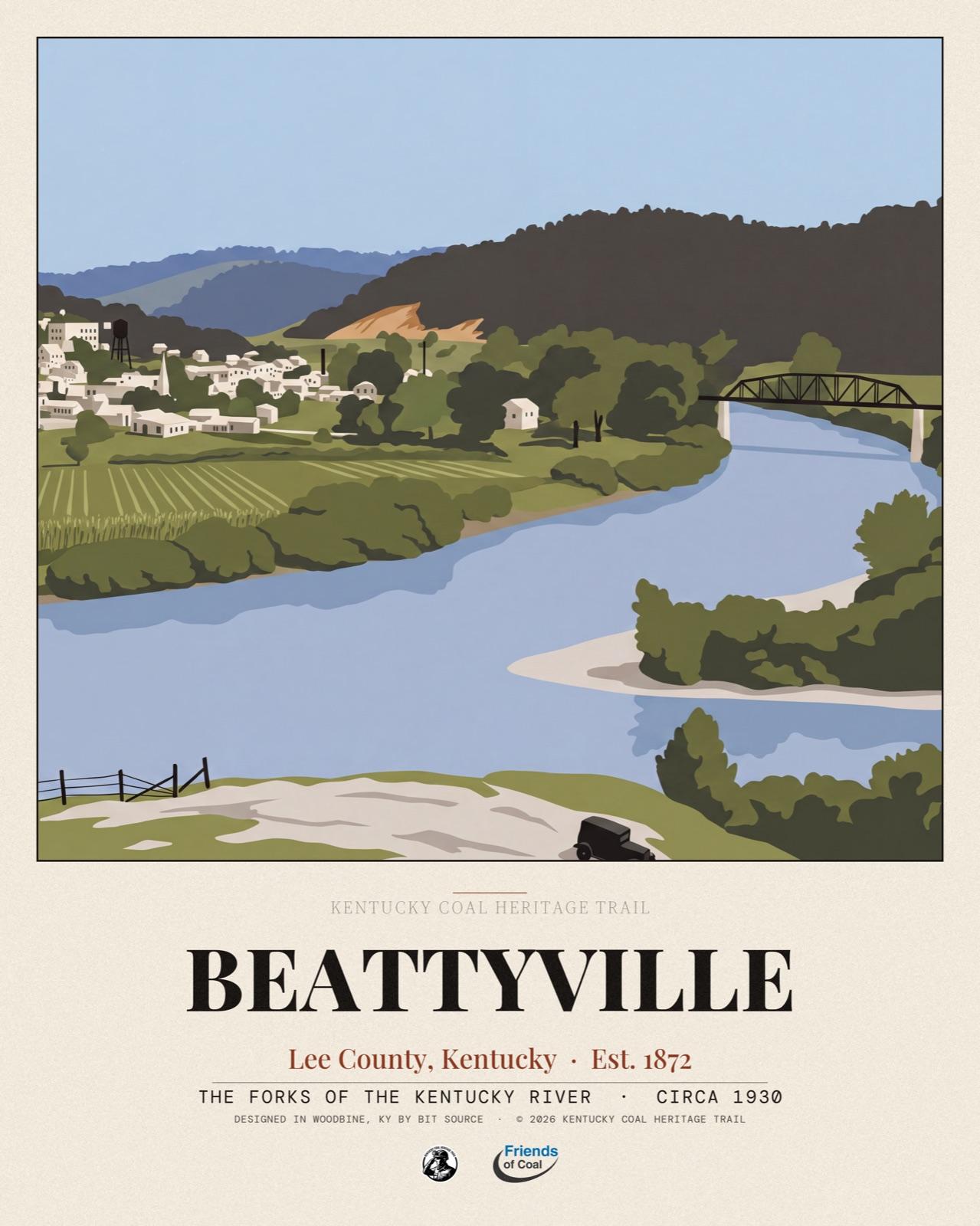
Welcome to Beattyville
Beattyville and Lee County have a rich commercial history. From the earliest recorded times, Native Americans harvested the resources of the area. The earliest inhabitants were cave dwellers in the Big and Little Sinking Creek area, who hunted and farmed. In later times, the Shawnee to the north and the Cherokee to the south made use of the plentiful game, and often clashed in this Dark and Bloody Ground - a no-man's land. A major route for these Indigenous nations was the Athawominee, or the "Path of the Armed Ones." It ran from the Cherokee nation in the Carolinas, through the Cumberland Gap, north to Lake Erie. A branch of this trail ran along the South Fork of the Kentucky River, through the Beattyville-Proctor area.
When the railroad came within reach of Beattyville in 1890, it created a boom, and the population jumped up from 300 to 1,000.
The Beattyville courthouse was completed in 1873. It was made of brick at a cost of $12,000.
The Namesake
Beattyville was originally known as Taylor’s Landing, then Beatty or Beatty Town. The town was named for Samuel Beatty, a local pioneer.
The Mines
Compiled from Dodrill's 10,000 Coal Company Stores
• The Avent Beattyville Coal Company operated before 1903, but the number of employees is unknown.
• The Beattyville Fuel Company operated from 1917 to 1925 and had 20 employees.
• The Black Fox Coal Company operated from 1933 to 1939 with 50 employees.
• The Frankfort Elevator Coal Company operated between 1924 and 1925, employing 40 people.
• The Jameson Coal Company operated from 1917 to 1921 with 40 employees.
• The L.C. Norman and Sons Mine operated from 1903 to 1906, employing 100 people.
• The McGuire Coal Company operated from 1903 to 1908 with 35 employees.
• The Richardson Coal Company operated between 1910 and 1914 with 75 employees.
• The Beattyville Company operated from 1916 to 1924 with 20 employees.
• The Beattyville Mine Company operated between 1921 and 1924, employing 20 people.
• The Thomas Jameson & Son Mine operated from 1926 to 1930 with 30 employees.
• The Thomas Logan Mine operated from 1909 to 1910, employing 11 people.
• The Warner Coal Company operated from 1917 to 1925 with 15 employees.
Important Places:
Fitchburg Charcoal Furnace
Completed in 1869, Fitchburg’s charcoal furnace was the largest charcoal iron furnace in the world for a time. Fred Fitch designed the furnace, and Sam Worthley, a stone mason from Scotland, completed construction.
Red River Gorge
The Red River Gorge is a canyon system on the Red River in east-central Kentucky. Geologically, it is part of the Pottsville Escarpment. The gorge lies within the Daniel Boone National Forest and was subsequently designated the Red River Gorge Geological Area, an area of around 29,000 acres. It was designated a National Natural Landmark and National Archaeological District and is listed on the National Register of Historic Places. The 13,379-acre Clifty Wilderness Area lies entirely within the geological area in the Red River Gorge.
This intricate canyon system features an abundance of high sandstone cliffs, rock shelters, waterfalls, and natural bridges. There are more than 100 natural sandstone arches in the Red River Gorge Geological Area. The multitude of sandstone and cliff-lines helped this area become one of the world's top rock climbing destinations and is home to the Red River Gorge Climbers' Coalition. The area is nicknamed the Red by climbers.
Kentucky Wild River
The Kentucky Wild River is the legal designation by the Kentucky General Assembly, through the Office of Kentucky Nature Preserves' Wild Rivers Program, for the section of Red River in the Upper Gorge. This is the only river with this designation in Kentucky.
Notable People
Sheriff William Sims was shot and killed at the age of 27 by a man, Oscar Morton, who became enraged when he was denied entrance to the county fair in Beattyville because he did not have a ticket. When the man got loud and verbally abusive with the gatekeeper, Sheriff Simms stepped in and warned him to be quiet. The man took out his anger on the sheriff, drawing two revolvers and shooting the sheriff three times, killing him instantly. The local jailer who was nearby returned fire, wounding the suspect, and with the help of several citizens subdued him. The next morning, an angry mob forced their way into the county jail, seized the suspect, and hanged him. Sheriff Sims had been sheriff in Lee County for two years and was up for reelection with no opposition. He was survived by his wife and three children.
Frank A. Lyon served as Postmaster for Beattyville in the late 19th century. It was unusual in that Lyon owned the building the post office was housed in.
Malcolm Kilduff was an American journalist, best known for making the public announcement of the death of U.S. President John F. Kennedy. Born in New York, Kilduff was Kennedy's assistant White House Press Secretary and the ranking press secretary on the November 1963 trip to Dallas, Texas where Kennedy was assassinated. Following his political career, Mac moved to Beattyville, where he worked as an editor for The Beattyville Enterprise newspaper and won a number of Kentucky Press Association awards.
In Beattyville, Kilduff was active in the Kiwanis Club, the Natural Bridge Park Association, and the Buckhorn Scenic Trails Association. He was also an admitted recovering alcoholic and often spoke to students and civic groups not only about his experience with President Kennedy but of his experiences with alcoholism and his recovery. Kilduff is buried in Arlington National Cemetery.
Rosemary Kilduff, the second wife of Mac, was also a columnist for the paper and an award-winning journalist. Rosemary was from Beattyville and returned to her hometown with her husband following a career in Washington, D.C. One of her columns, dealing with methods of forecasting the weather in mountain folklore, became the impetus for the town's annual fall festival, the Woolly Worm Festival held the third weekend in October.
Notable Events:
Woolly Worm Festival
Since 1988, on the third weekend after the first Monday of October, the Main Street of Beattyville closes to traffic for the annual Woolly Worm Festival. It operates for three days: Friday, "Opening Day"; Saturday, "Parade Day"; and Sunday, "Closing Day", which also features a large car show.
The name "woolly worm" refers to the woolly bear caterpillar. The official mascot, "Woolly the Woolly Worm," is used as an image on some local merchandise and flyers. A round hay bale caricature of Woolly stands beside the welcome sign to Beattyville. The festival is the outgrowth of a series of stories by Beattyville native Rosemary Kilduff that tracked the predictions of winter weather based on local folklore. The severity of upcoming winter weather was said to be foretold by the relative proportions of black to brown coloration of the caterpillars. Kilduff penned columns in the local newspaper in the 1980s that collected woolly worm sightings by local residents.
During the festival, numerous musicians perform almost constantly on one of two stages, and dozens of booths offer a wide variety of merchandise and food. Helicopter tours of Beattyville and Lee County are available. The "Woolly Worm Races" are won by coaxing one of these "Hairy Caterpillars" to the top of a string. The first one to reach the top wins, with the only rule being "No Touching"; there is usually a cash prize for the winner.
Audio transcript
THE TOWN OF: Beattyville, Lee County Kentucky
Welcome to Beattyville
The town of Beattyville was erected in 1870. Three forks (North, Middle, and South) of
the Kentucky River come together in downtown Beattyville.
Beattyville and Lee County have a rich commercial history. From the earliest recorded
times, Native Americans harvested the resources of the area. The earliest inhabitants
were cave dwellers in the Big and Little Sinking Creek area, who hunted and farmed. In
later times, the Shawnee to the north and the Cherokee to the south made use of the
plentiful game, and often clashed in this Dark and Bloody Ground - a no-man's land. A
major route for these Indigenous nations was the Athawominee, or the "Path of the
Armed Ones." It ran from the Cherokee nation in the Carolinas, through the
Cumberland Gap, north to Lake Erie. A branch of this trail ran along the South Fork of
the Kentucky River, through the Beattyville-Proctor area.
When the railroad came within reach of Beattyville in 1890, it created a boom, and the
population jumped up from 300 to 1,000.
The Beattyville courthouse was completed in 1873. It was made of brick at a cost of
$12,000.

The Namesake
Beattyville was originally known as Taylor’s Landing, then Beatty or Beatty Town. The
town was named for Samuel Beatty, a local pioneer.

The Mines
                 Compiled from Dodrill's 10,000 Coal Company Stores

   1. The Avent Beattyville Coal Company operated before 1903, but the number
      of employees is unknown.
   2. The Beattyville Fuel Company operated from 1917 to 1925 and had 20
      employees.
   3. The Black Fox Coal Company operated from 1933 to 1939 with 50
      employees.
   4. The Frankfort Elevator Coal Company operated between 1924 and 1925,
      employing 40 people.
   5. The Jameson Coal Company operated from 1917 to 1921 with 40
      employees.
   6. The L.C. Norman and Sons Mine operated from 1903 to 1906, employing
      100 people.

   7. The McGuire Coal Company operated from 1903 to 1908 with 35 employees.
   8. The Richardson Coal Company operated between 1910 and 1914 with 75
       employees.
   9. The Beattyville Company operated from 1916 to 1924 with 20 employees.
   10. The Beattyville Mine Company operated between 1921 and 1924, employing
       20 people.
   11. The Thomas Jameson & Son Mine operated from 1926 to 1930 with 30
       employees.
   12. The Thomas Logan Mine operated from 1909 to 1910, employing 11 people.
   13. The Warner Coal Company operated from 1917 to 1925 with 15 employees.

Important Places:
Fitchburg Charcoal Furnace
Completed in 1869, Fitchburg’s charcoal furnace was the largest charcoal iron furnace
in the world for a time. Fred Fitch designed the furnace, and Sam Worthley, a stone
mason from Scotland, completed construction.

Red River Gorge
The Red River Gorge is a canyon system on the Red River in east-central Kentucky.
Geologically, it is part of the Pottsville Escarpment. The gorge lies within the Daniel
Boone National Forest and was subsequently designated the Red River Gorge
Geological Area, an area of around 29,000 acres. It was designated a National Natural
Landmark and National Archaeological District and is listed on the National Register of
Historic Places. The 13,379-acre Clifty Wilderness Area lies entirely within the
geological area in the Red River Gorge.
This intricate canyon system features an abundance of high sandstone cliffs, rock
shelters, waterfalls, and natural bridges. There are more than 100 natural sandstone
arches in the Red River Gorge Geological Area. The multitude of sandstone and
cliff-lines helped this area become one of the world's top rock climbing destinations and
is home to the Red River Gorge Climbers' Coalition. The area is nicknamed the Red by
climbers.
Kentucky Wild River
The Kentucky Wild River is the legal designation by the Kentucky General Assembly,
through the Office of Kentucky Nature Preserves' Wild Rivers Program, for the section
of Red River in the Upper Gorge. This is the only river with this designation in Kentucky.

Notable People
Sheriff William Sims was shot and killed at the age of 27 by a man, Oscar Morton, who
became enraged when he was denied entrance to the county fair in Beattyville because

he did not have a ticket. When the man got loud and verbally abusive with the
gatekeeper, Sheriff Simms stepped in and warned him to be quiet. The man took out his
anger on the sheriff, drawing two revolvers and shooting the sheriff three times, killing
him instantly. The local jailer who was nearby returned fire, wounding the suspect, and
with the help of several citizens subdued him. The next morning, an angry mob forced
their way into the county jail, seized the suspect, and hanged him. Sheriff Sims had
been sheriff in Lee County for two years and was up for reelection with no opposition.
He was survived by his wife and three children.
Frank A. Lyon served as Postmaster for Beattyville in the late 19th century. It was
unusual in that Lyon owned the building the post office was housed in.
Malcolm Kilduff was an American journalist, best known for making the public
announcement of the death of U.S. President John F. Kennedy. Born in New York,
Kilduff was Kennedy's assistant White House Press Secretary and the ranking press
secretary on the November 1963 trip to Dallas, Texas where Kennedy was
assassinated. Following his political career, Mac moved to Beattyville, where he worked
as an editor for The Beattyville Enterprise newspaper and won a number of Kentucky
Press Association awards.
In Beattyville, Kilduff was active in the Kiwanis Club, the Natural Bridge Park
Association, and the Buckhorn Scenic Trails Association. He was also an admitted
recovering alcoholic and often spoke to students and civic groups not only about his
experience with President Kennedy but of his experiences with alcoholism and his
recovery. Kilduff is buried in Arlington National Cemetery.
Rosemary Kilduff, the second wife of Mac, was also a columnist for the paper and an
award-winning journalist. Rosemary was from Beattyville and returned to her hometown
with her husband following a career in Washington, D.C. One of her columns, dealing
with methods of forecasting the weather in mountain folklore, became the impetus for
the town's annual fall festival, the Woolly Worm Festival held the third weekend in
October.

Notable Events:
Woolly Worm Festival
Since 1988, on the third weekend after the first Monday of October, the Main Street of
Beattyville closes to traffic for the annual Woolly Worm Festival. It operates for three
days: Friday, "Opening Day"; Saturday, "Parade Day"; and Sunday, "Closing Day",
which also features a large car show.
The name "woolly worm" refers to the woolly bear caterpillar. The official mascot,
"Woolly the Woolly Worm," is used as an image on some local merchandise and flyers.
A round hay bale caricature of Woolly stands beside the welcome sign to Beattyville.

The festival is the outgrowth of a series of stories by Beattyville native Rosemary Kilduff
that tracked the predictions of winter weather based on local folklore. The severity of
upcoming winter weather was said to be foretold by the relative proportions of black to
brown coloration of the caterpillars. Kilduff penned columns in the local newspaper in
the 1980s that collected woolly worm sightings by local residents.
During the festival, numerous musicians perform almost constantly on one of two
stages, and dozens of booths offer a wide variety of merchandise and food. Helicopter
tours of Beattyville and Lee County are available. The "Woolly Worm Races" are won by
coaxing one of these "Hairy Caterpillars" to the top of a string. The first one to reach the
top wins, with the only rule being "No Touching"; there is usually a cash prize for the
winner.