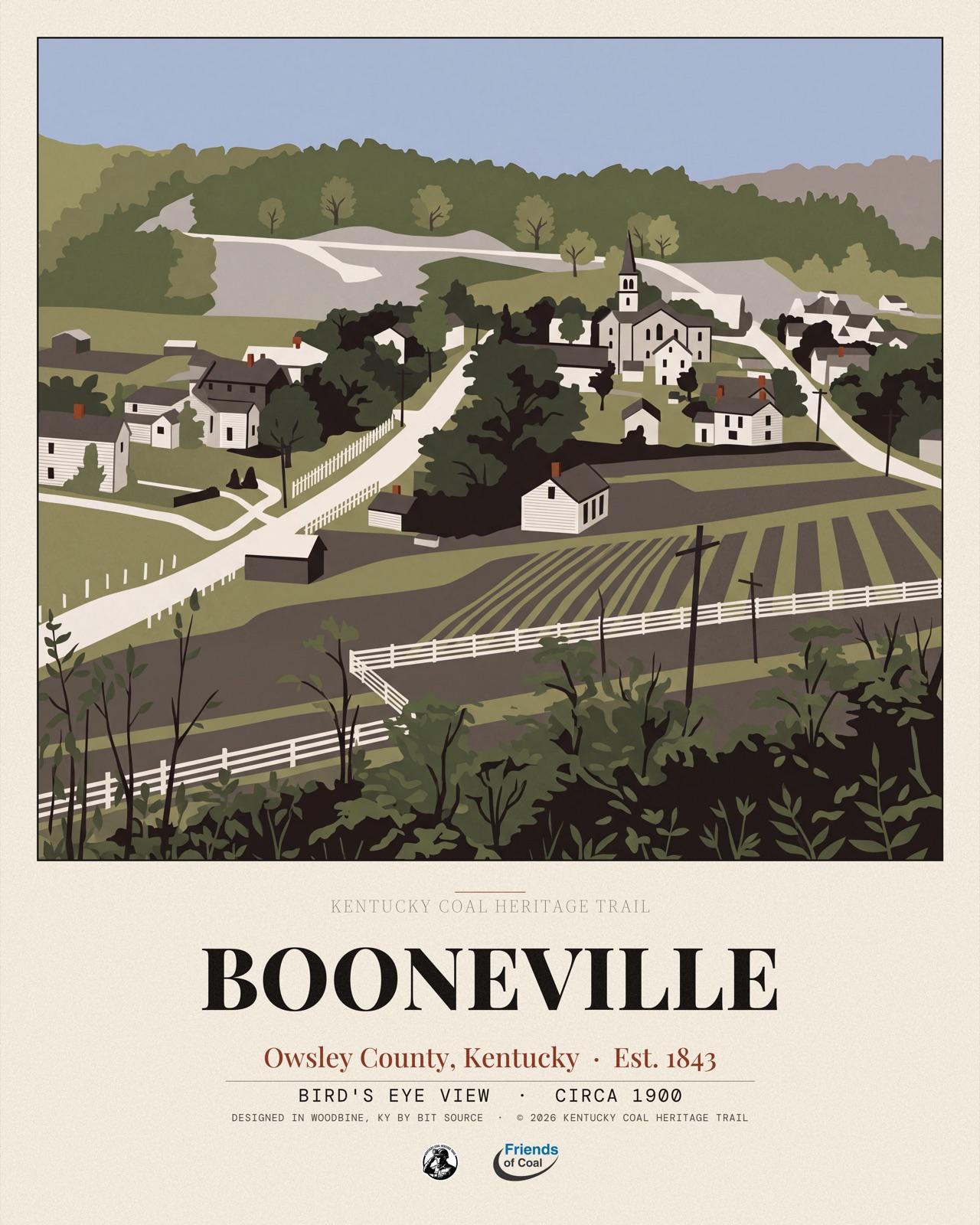
Welcome to Booneville
Consisting at the time of only a log courthouse, Booneville became the county seat when Owsley County was formed on May 20, 1844. Booneville was formally incorporated as a city by the state assembly on March 1, 1847.
The post office opened in 1844.
During the Civil War, Booneville was a crossroads for Union and Confederate regiments. The town was also threatened by Confederate guerrillas but avoided the destruction.
The Owsley County Courthouse burned in January 1929, destroying all early records. Sadly, on January 5, 1967 the courthouse again caught on fire, doing serious damage to the building.
The Mines
Significant coal production ceased in Owsley County in 2012.
Important Places
The Abraham Lincoln Relief Sculpture, locally known as Abe Lincoln Rock or Abraham Lincoln Rock, is located off of Highway 846 in the Conkling community and was carved by a traveling pack peddler named Granville Johnson in the 1930s. The sculpture is in the inventory of folk art in the Smithsonian American Art Museum. Area legend indicates that Johnson arrived in the area ill and needed assistance. The family of John Williams took him in and cared for him on the farm located south of Booneville. Once he began recovering his strength, he took daily walks along the hillside behind the Williams’ residence. Once he was fully recovered and preparing to leave the area, he revealed the sculpture to his family as his gift for their generosity. The location is now owned by the Owsley County Fiscal Court, but there is no signage; thus, it’s difficult for tourists to locate.
Notable People
Earle Combs, Hall of Fame Baseball player for the New York Yankees, was born in the unincorporated town of Pebworth close to Booneville. Combs batted leadoff and played center field on the Yankees' fabled 1927 team often referred to as Murderers' Row.
Audio transcript
THE TOWN OF: Booneville, Owsley County, Kentucky
Welcome to Booneville
Consisting at the time of only a log courthouse, Booneville became the county seat
when Owsley County was formed on May 20, 1844. Booneville was formally
incorporated as a city by the state assembly on March 1, 1847.
The post office opened in 1844.
During the Civil War, Booneville was a crossroads for
Union and Confederate regiments. The town was also threatened by Confederate
guerrillas but avoided the destruction.
The Owsley County Courthouse burned in January 1929, destroying all early records.
Sadly, on January 5, 1967 the courthouse again caught on fire, doing serious damage
to the building.
The Namesake
The town of Booneville was originally known as Moore’s Station after its chief
landowner, Elias Moore, who donated the land for the town. The town was later
renamed Boone’s Station and subsequently changed to Booneville in honor of Daniel
Boone.
The Mines
Significant coal production ceased in Owsley County in 2012.
Important Places
The Abraham Lincoln Relief Sculpture, locally known as Abe Lincoln Rock or
Abraham Lincoln Rock, is located off of Highway 846 in the Conkling community and
was carved by a traveling pack peddler named Granville Johnson in the 1930s. The
sculpture is in the inventory of folk art in the Smithsonian American Art Museum. Area
legend indicates that Johnson arrived in the area ill and needed assistance. The family
of John Williams took him in and cared for him on the farm located south of Booneville.
Once he began recovering his strength, he took daily walks along the hillside behind the
Williams’ residence. Once he was fully recovered and preparing to leave the area, he
revealed the sculpture to his family as his gift for their generosity. The location is now
owned by the Owsley County Fiscal Court, but there is no signage; thus, it’s difficult for
tourists to locate.
Notable People
Earle Combs, Hall of Fame Baseball player for the New York Yankees, was born in the
unincorporated town of Pebworth close to Booneville. Combs batted leadoff and played
center field on the Yankees' fabled 1927 team often referred to as Murderers' Row.