Welcome to Lynch
At the turn of the 20th century, deep within the Appalachian Mountains, there was an area so remote that it was not yet named. This small area at the foot of Black Mountain, the highest peak in Kentucky, held an untapped resource: metallurgical coal, which would soon play a key role in the industrialization of the United States.
In the early 1900s, U.S. Coal and Coke Company (later to become U.S. Steel) began the exploration of this small area and discovered several coal seams that collectively would soon be considered one of the best gas and coking coals in the United States.
The U.S. Coal and Coke Company made the decision to begin mining in this area only to discover that, due to the remoteness, the company would have to supply all the fundamentals for the miner and their families. In the U.S. Steel fashion, it was decided that this little area in the mountains would be developed into a model coal camp.
Beginning in early 1917 the United States Coal & Coke Company purchased 40,000 acres of mountainous timberland in the Appalachian Mountain Range located in Eastern Kentucky and built a coal mining operation here that would last over a period of 60 years.
The U.S. Coal and Coke Company built Lynch on part of a 19,000-acre tract of land, which at the time made it the largest coal camp in the world. By the 1940s, Lynch was considered the “Cadillac” of coal mining towns, with beautiful public buildings, paved streets, indoor plumbing and sewage, plenty of land for recreation, and excellent healthcare facilities servicing a population of around 4,000 miners and 10,000 total residents from almost forty countries (U.S. Steel recruited workers for Lynch largely from Ellis Island).
For the time, this was truly a major engineering accomplishment. When the company recognized a shortage of available man-power in the area, they began recruiting immigrants as they arrived into the United States. Also recruited were African Americans from the old plantations of the South looking for a better life. The company utilized this workforce to not only produce some of the finest quality bituminous coal but to build a town that the miners would be proud to call home. A theater, an impressive 300 room hotel, recreational areas (baseball fields, tennis courts, etc.), a hospital, company power plant, schools, churches, and hundreds of modern two-story homes with enough land for a vegetable and flower garden were all built. It was a unique microcosm of the American melting pot with over 40 languages represented in the early years.
Overall, in addition to being a leader in the American Revolution, Lynch was known for its quality healthcare, education, housing and social services.
The Namesake:
This remote area in the foothills of Black Mountain became Lynch, named for Thomas Lynch, the president of U.S. Coal and Coke at that time the area was developed. The town of Lynch became incorporated in 1963.
The Mines:
The C or Darby and B or Kelioka seams averaged five feet thick and were considered to be some of the highest quality metallurgical coal in the world.
Mine No. 31 set the world’s record in 1923 for coal production in a nine-hour shift when miners produced 12,820 tons of coal.
Active coal mining in Mine 31 ceased in the early 1960s, and the mine closed. In the late 1970s, the two main haulage tunnels were rehabilitated to around 1800 feet in the mountain where they intercepted a shaft to an upper coal seam and the surrounding mine area sealed off. A belt conveyor was installed in one tunnel to transport coal to a new coal silo, where coal was loaded on trains to be transported to a central preparation plant. The Portal area operated in this manner until the early 1990s, when mining ceased in the upper seams.
IMPORTANT PLACES:
PORTAL 31 EXHIBITION MINE
In 1917, U.S. Coal and Coke Co. (U.S. Steel) opened Mine 31 in Lynch. In 1996, Arch Coal, Inc., the then owner of the site, donated the property to Harlan County for public use. After 13 years of fundraising, engineering and construction, The Southeast Education Foundation, Inc. (SEFI) opened the Portal 31 Exhibition Mine to the public in 2009. (SEFI is a non-profit organization created in 1981 with the exclusive purpose of supporting Southeast Community College of the Kentucky Community and Technical College System and the Tri-City communities of Cumberland, Benham and Lynch which are contiguous.)
Interactive cast figures in the mine tell visitors the story of Kentucky coal mining. While riding a specially built mantrip on light rail, simulated mining scenes demonstrate how working conditions improved as a result of technological innovations. The Kentucky Chapter of the American Council of Engineering Companies (ACEC) awarded Portal 31 with its “Grand Conceptor” Award in March of 2010 to qualify it for the national competition. The project was then selected for an Honor Award as one of the top 24 (out of 163 entries throughout the nation) engineering projects by ACEC as preeminent engineering achievements for 2010. Judging for the prestigious Engineering Excellence Awards (often referred to as the “Academy Awards” of engineering) is conducted by a distinguished panel of 25-30 engineers and architects, along with representatives from government, media, and academia. Criteria for awards include uniqueness and originality, technical, social and economic value, complexity, and success of the projects in meeting goals.
U.S. Steel built numerous buildings as part of its development of a company town to support the coal mining operations, many of which still stand to this day. Some of the notable buildings constructed by U.S. Steel in Lynch include:
• Coal Tipple: One of the largest coal tipples in the world at the time, where coal was sorted and loaded into railcars for shipment.
• Powerhouse: Provided electricity for the mines and the town, essential for both industrial operations and residential life.
• Central Office: U.S. Steel's administrative headquarters for operations in Lynch, often referred to as the company office building.
• Miners’ Housing: U.S. Steel built hundreds of homes for the miners and their families, designed in various styles ranging from simple cottages to more elaborate homes for managers.
• Lynch Hospital: A medical facility built to serve miners and their families, offering both emergency and routine healthcare.
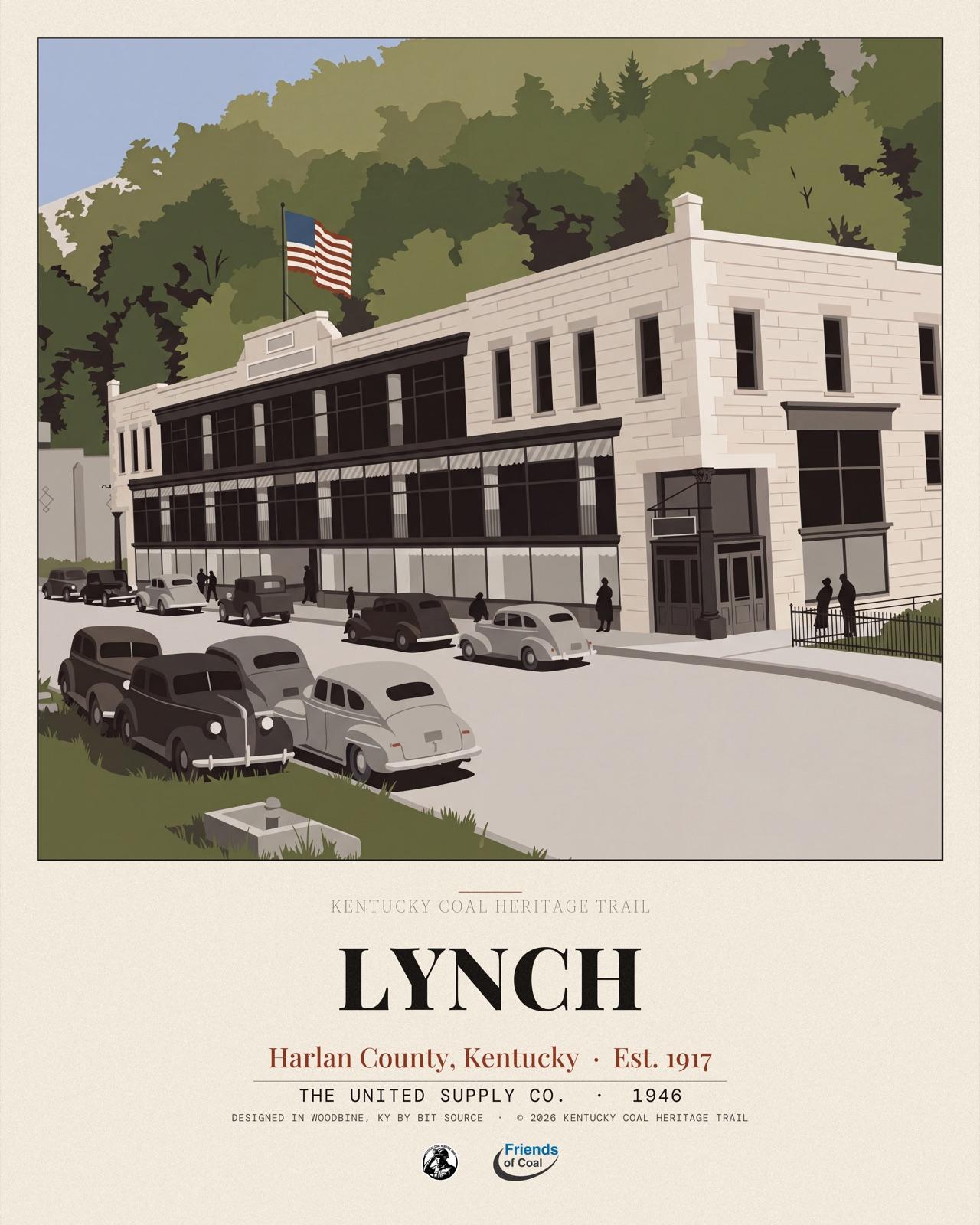
• Company Store: A general store where miners and their families could purchase groceries, clothing, and other necessities. Many coal towns had such stores that were central to the community.
• Lynch High School: Constructed by U.S. Steel to provide education for the children of miners.
• Churches: U.S. Steel built several churches for various denominations to serve the religious needs of the community. Most notable is the St. Mary’s Catholic Church, which served a diverse congregation including many immigrants from Eastern Europe, Italy, and Ireland. The Catholic workers brought with them their religious traditions, and U.S. Steel supported the establishment of the church to foster a sense of community and stability in the town. The church was a place where families could worship and gather for social events, which helped to solidify community bonds.
• Recreational Facilities: These included a clubhouse, movie theater, and sports fields to provide leisure activities for the residents of Lynch.
• The U.S. Steel bath house was opened in 1920. This building served as the place for the miners to “get clean” following their shifts underground. During the “heyday” of mining, over 1,000 men could use the bathhouse facilities simultaneously.
NOTABLE PEOPLE
Although MLB hall of famer Earle Combs was born in nearby Pebworth, Kentucky, his ties to the Harlan County region are significant. Combs was a star outfielder for the New York Yankees and was a key member of the famous “Murderers' Row” team of the 1920s. He was inducted into the Baseball Hall of Fame in 1970. While not directly from Lynch, the area's coal towns, including Lynch, have long claimed Combs as a regional figure of pride.
Audio transcript
THE TOWN OF: Lynch, Harlan County, Kentucky

Welcome to Lynch

At the turn of the 20th century, deep within the Appalachian Mountains, there was an
area so remote that it was not yet named. This small area at the foot of Black Mountain,
the highest peak in Kentucky, held an untapped resource: metallurgical coal, which
would soon play a key role in the industrialization of the United States.

In the early 1900s, U.S. Coal and Coke Company (later to become U.S. Steel) began
the exploration of this small area and discovered several coal seams that collectively
would soon be considered one of the best gas and coking coals in the United States.

The U.S. Coal and Coke Company made the decision to begin mining in this area only
to discover that, due to the remoteness, the company would have to supply all the
fundamentals for the miner and their families. In the U.S. Steel fashion, it was decided
that this little area in the mountains would be developed into a model coal camp.

Beginning in early 1917 the United States Coal & Coke Company purchased 40,000
acres of mountainous timberland in the Appalachian Mountain Range located in Eastern
Kentucky and built a coal mining operation here that would last over a period of 60
years.

The U.S. Coal and Coke Company built Lynch on part of a 19,000-acre tract of land,
which at the time made it the largest coal camp in the world. By the 1940s, Lynch was
considered the “Cadillac” of coal mining towns, with beautiful public buildings, paved
streets, indoor plumbing and sewage, plenty of land for recreation, and excellent
healthcare facilities servicing a population of around 4,000 miners and 10,000 total
residents from almost forty countries (U.S. Steel recruited workers for Lynch largely
from Ellis Island).

For the time, this was truly a major engineering accomplishment. When the company
recognized a shortage of available man-power in the area, they began recruiting
immigrants as they arrived into the United States. Also recruited were African
Americans from the old plantations of the South looking for a better life. The company
utilized this workforce to not only produce some of the finest quality bituminous coal but
to build a town that the miners would be proud to call home. A theater, an impressive
300 room hotel, recreational areas (baseball fields, tennis courts, etc.), a hospital,
company power plant, schools, churches, and hundreds of modern two-story homes
with enough land for a vegetable and flower garden were all built. It was a unique
microcosm of the American melting pot with over 40 languages represented in the early
years.

Overall, in addition to being a leader in the American Revolution, Lynch was known for
its quality healthcare, education, housing and social services.

The Namesake:

This remote area in the foothills of Black Mountain became Lynch, named for Thomas
Lynch, the president of U.S. Coal and Coke at that time the area was developed. The
town of Lynch became incorporated in 1963.

The Mines:

The C or Darby and B or Kelioka seams averaged five feet thick and were considered to
be some of the highest quality metallurgical coal in the world.

Mine No. 31 set the world’s record in 1923 for coal production in a nine-hour shift when
miners produced 12,820 tons of coal.

Active coal mining in Mine 31 ceased in the early 1960s, and the mine closed. In the
late 1970s, the two main haulage tunnels were rehabilitated to around 1800 feet in the
mountain where they intercepted a shaft to an upper coal seam and the surrounding
mine area sealed off. A belt conveyor was installed in one tunnel to transport coal to a
new coal silo, where coal was loaded on trains to be transported to a central preparation
plant. The Portal area operated in this manner until the early 1990s, when mining
ceased in the upper seams.

IMPORTANT PLACES:

PORTAL 31 EXHIBITION MINE

In 1917, U.S. Coal and Coke Co. (U.S. Steel) opened Mine 31 in Lynch. In 1996, Arch
Coal, Inc., the then owner of the site, donated the property to Harlan County for public
use. After 13 years of fundraising, engineering and construction, The Southeast
Education Foundation, Inc. (SEFI) opened the Portal 31 Exhibition Mine to the public in
2009. (SEFI is a non-profit organization created in 1981 with the exclusive purpose of
supporting Southeast Community College of the Kentucky Community and Technical
College System and the Tri-City communities of Cumberland, Benham and Lynch which
are contiguous.)

Interactive cast figures in the mine tell visitors the story of Kentucky coal mining. While
riding a specially built mantrip on light rail, simulated mining scenes demonstrate how
working conditions improved as a result of technological innovations. The Kentucky
Chapter of the American Council of Engineering Companies (ACEC) awarded Portal 31
with its “Grand Conceptor” Award in March of 2010 to qualify it for the national
competition. The project was then selected for an Honor Award as one of the top 24
(out of 163 entries throughout the nation) engineering projects by ACEC as preeminent
engineering achievements for 2010. Judging for the prestigious Engineering Excellence
Awards (often referred to as the “Academy Awards” of engineering) is conducted by a
distinguished panel of 25-30 engineers and architects, along with representatives from

government, media, and academia. Criteria for awards include uniqueness and
originality, technical, social and economic value, complexity, and success of the projects
in meeting goals.

U.S. Steel built numerous buildings as part of its development of a company town to
support the coal mining operations, many of which still stand to this day. Some of the
notable buildings constructed by U.S. Steel in Lynch include:
   1. Coal Tipple: One of the largest coal tipples in the world at the time, where coal
      was sorted and loaded into railcars for shipment.
   2. Powerhouse: Provided electricity for the mines and the town, essential for both
      industrial operations and residential life.
   3. Central Office: U.S. Steel's administrative headquarters for operations in Lynch,
      often referred to as the company office building.
   4. Miners’ Housing: U.S. Steel built hundreds of homes for the miners and their
      families, designed in various styles ranging from simple cottages to more
      elaborate homes for managers.
   5. Lynch Hospital: A medical facility built to serve miners and their families,
      offering both emergency and routine healthcare.
   6. Company Store: A general store where miners and their families could purchase
      groceries, clothing, and other necessities. Many coal towns had such stores that
      were central to the community.
   7. Lynch High School: Constructed by U.S. Steel to provide education for the
      children of miners.
   8. Churches: U.S. Steel built several churches for various denominations to serve
      the religious needs of the community. Most notable is the St. Mary’s Catholic
      Church, which served a diverse congregation including many immigrants from
      Eastern Europe, Italy, and Ireland. The Catholic workers brought with them their
      religious traditions, and U.S. Steel supported the establishment of the church to
      foster a sense of community and stability in the town. The church was a place
      where families could worship and gather for social events, which helped to
      solidify community bonds.
   9. Recreational Facilities: These included a clubhouse, movie theater, and sports
      fields to provide leisure activities for the residents of Lynch.
   10. The U.S. Steel bath house was opened in 1920. This building served as the
       place for the miners to “get clean” following their shifts underground. During the
       “heyday” of mining, over 1,000 men could use the bathhouse facilities
       simultaneously.

NOTABLE PEOPLE
Although MLB hall of famer Earle Combs was born in nearby Pebworth, Kentucky, his
ties to the Harlan County region are significant. Combs was a star outfielder for the New
York Yankees and was a key member of the famous “Murderers' Row” team of the
1920s. He was inducted into the Baseball Hall of Fame in 1970. While not directly from
Lynch, the area's coal towns, including Lynch, have long claimed Combs as a regional
figure of pride.