Welcome to Peach Orchard
The coal town of Peach Orchard was the first coal town in the Big Sandy Valley. There were actually two Peach Orchard towns: one known as Old Peach Orchard, the other known as New Peach Orchard. Old Peach Orchard was located just north of present-day Richardson along the banks of the Levisa Fork. New Peach Orchard was located along Nat’s Creek, where the town of Richard was built as a railroad for coal being produced.
Peach Orchard was located about 15 miles south of Louisa and became a prominent coal mining town in the late 19th and early 20th centuries. The town was home to several coal mines, providing employment to many residents and attracted workers from other areas.
The Namesake
The town was first called Mellenburg in honor of William H. Mellen, the first superintendent of Peach Orchard Coal Company who helped develop many of the town’s original structures. However, the name was later changed because of the Peach Orchard vein of coal in which the miners were working.
The Mines
Coal mining was introduced to Peach Orchard by Judge Archibald Borders, who was a farmer, merchant, and the first Judge of Lawrence County. Borders was instrumental in opening the merchant trade in Peach Orchard. He also built the Big Sandy, a river steamboat used by General James Garfield to carry supplies to Pike County during the war.
Due to arrangements made by Borders, investors George Carlisle, R. B. Bowler, and other capitalists came to the area from Cincinnati and developed mines. Borders sold nearly 2000 acres of his property to allow for the creation of these mining operations.
In 1847, Peach Orchard Coal Company was formed and William H. Mellen was hired as superintendent to develop the mining operation. The company imported its own sawmill, and while one group of men felled the forest, another sawed the lumber. A row of white frame cottages was constructed along the river bank, while others extended up the hollow. These houses were described as being of superior quality. The residence constructed a short time later for William H. Mellen was said to have been equal to the suburban mansions of Cincinnati.
Peach Orchard Coal Company built a number of other structures around the town including a general store, church and school. The school building was a white frame structure like the miners' homes and was equipped with good seats and ventilation. In addition, a grist mill was erected to grind wheat and corn in order to provide bread for the people and food for the work animals. The mill was the best of its kind in the area, with nearly all farmers within a radius of twenty miles bringing their grain to be ground.
Coal was tipped into barges to await a rise in the river sufficient to carry it to market. In 1859, the company invited John Floyd, a former governor of Virginia who owned coal land along the Tug Fork, to join them in an effort to slackwater both rivers. The Tug River and Big Sandy River form the boundary line between what was then the western part of Virginia and Kentucky. Meetings were held at Peach Orchard and at Catlettsburg. An engineer by the name of Ledbetter, who had been engaged in a similar project on the Muskingum River in Ohio, reported the practicability of such an undertaking. However, the outbreak of the Civil War interrupted not only the plans for improvements in transportation but also put an end to all operations at Peach Orchard.
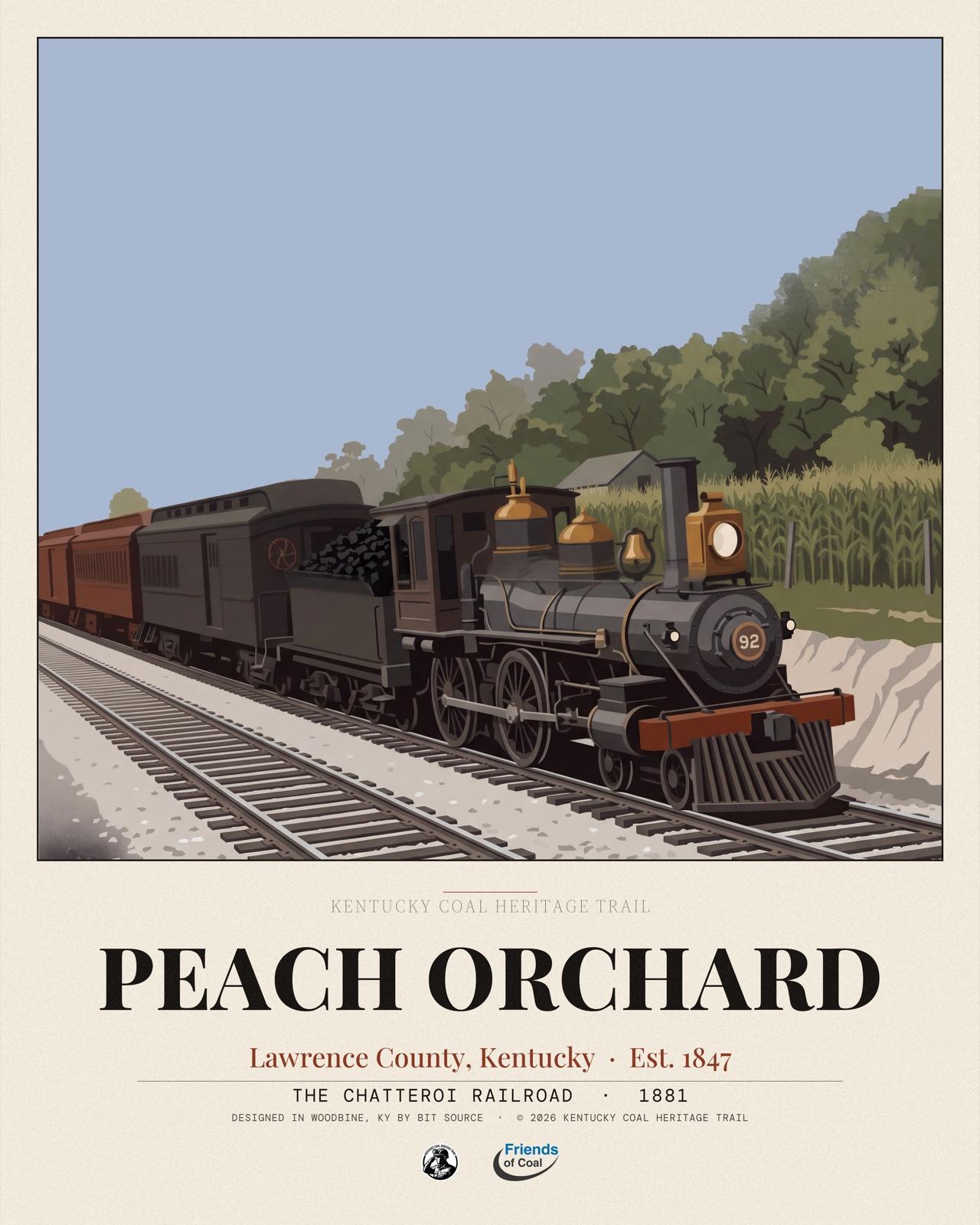
The last barge of coal was shipped early in the spring of 1861, and Mellen soon moved his family back to Cincinnati. He and several of the other officials joined the Union Army and never returned to Lawrence County. Henry Denby served as superintendent during the war period. The mill and the store were kept in operation for some time, but coal mining was not resumed on a large scale due to the great loss of boats on snags and rocks and because there was not enough water to float the barges during summer months. Denby was succeeded by George S. Richardson, a businessman from Massachusetts. During his superintendency, the company store operated on a large scale, and the mills were kept busy grinding grain for the farmers. The mines were profitable during Richardson’s tenure, which included the construction of a standard gauge railroad from the Ohio River to Peach Orchard.
The railroad was completed in 1882, ushering in a new mining era. The Great Western Mining and Manufacturing Company was formed and located in what became known as New Peach Orchard, soon employing 556 miners. The Palace Hotel was built in New Peach Orchard and became a focal point of the town. Additional construction included a church, school, large general store, railroad station, and post office. Telephone service began in 1890, with streetlights being installed in 1891. Immigrants from Italy and Hungary arrived to work in the mines.
Mining ceased in Old Peach Orchard in 1891, and in 1893 the Knights of Labor held a strike for over a month, seriously disrupting production in New Peach Orchard.
The depression severely damaged the Great Western Mining and Manufacturing Company. Peach Orchard Coal Company began controlling the mine in 1894 but had limited success. Despite investments in new equipment, production declined and by 1908 only 40 employees remained.
Following World War II, strip mining operations took place in Lawrence County. In 1970, a firm from Texas surface mined along Nat’s Creek where Old Peach Orchard was located. During this strip mining, both Old and New Peach Orchard were destroyed in the reclamation process.
Notable Events
39th Kentucky Mounted Infantry
The 39th Kentucky Mounted Infantry was organized in the Fall of 1862 at Old Peach Orchard. The volunteers for this regiment were drawn from the counties bordering the Big Sandy Valley, but some came from as far away as Tennessee, Virginia, and North Carolina. While the 39th did not participate in any of the Civil War's major battles, it saw much service in combating the numerous guerrilla bands, as well as regular Confederate forces, deep in the Appalatchan Mountains. Some of the battles and skirmishes that the 39th did participate in include the second battle at Cynthiana, Harrison County, Kentucky; the battle at Licking Meadows, Magoffin County, Kentucky (also known as Puncheon Creek or Half Mountain); the first and second battles at Saltville, Virginia; the Johnson County Boat Fight; Turman's Ferry; and a host of other smaller skirmishes.