Welcome to Stone
The community of Stone was established in 1912. Stone is located just across the Tug Fork from Williamson, WV and upstream from Belfry, KY along Pond Creek.
The Namesake
Stone was named for Galen Stone, the Chairman of the Board for Pond Creek Coal Company.
The Mines
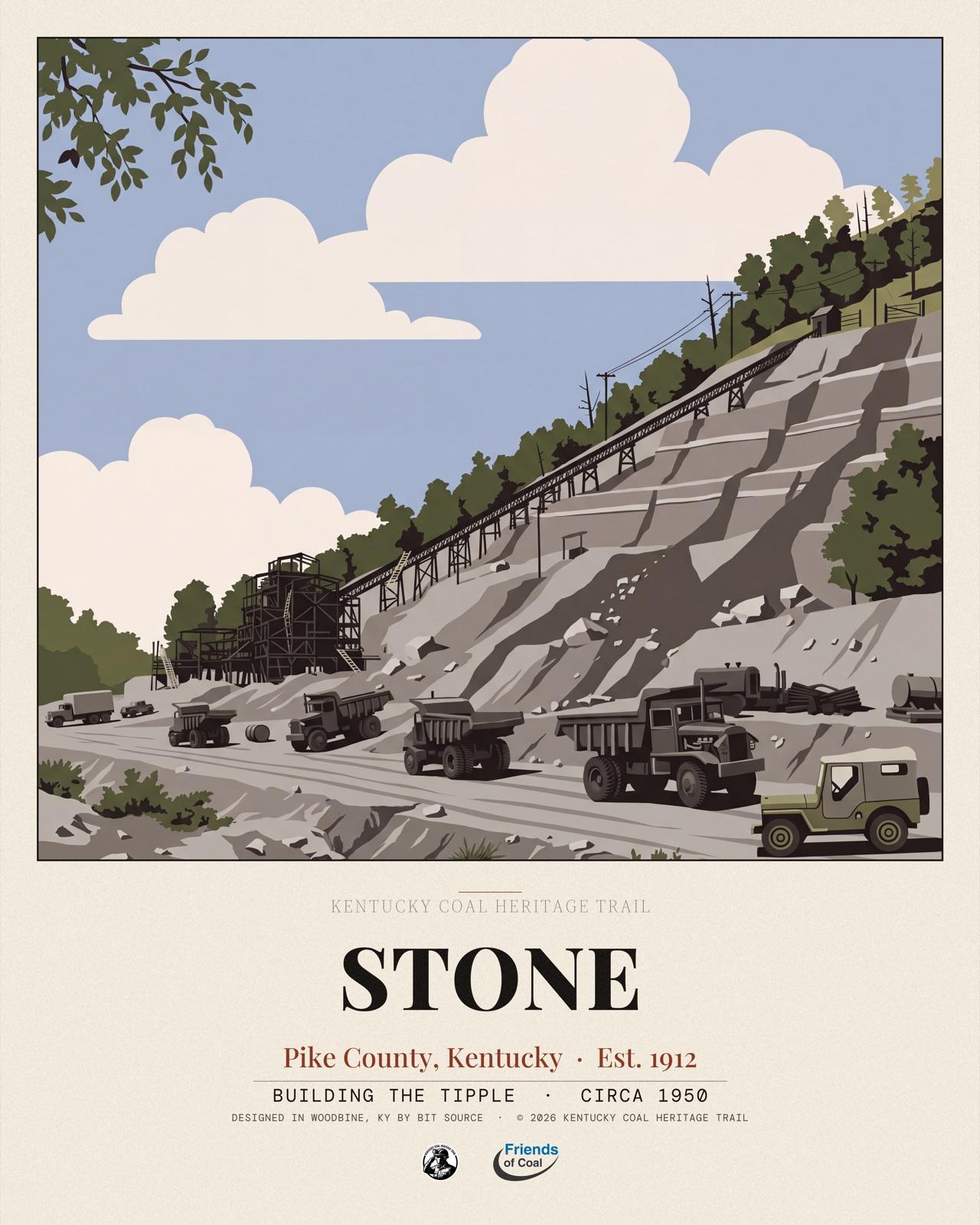
The Pond Creek Coal Company was formed in 1912 and later sold in 1922 to a subsidiary of Ford Motor Company, known as Fordson Coal Company. Henry Ford purchased the company in order to produce coal to assist in the powering of his automotive industry.
Fordson Coal employed as many as 1500 people and was one of the largest bituminous coal operations in Appalachia at that time. This acquisition included more than 600 houses in an 8 mile stretch from the communities of Hardy to McVeigh. Once the managers from Ford arrived from Detroit, upon surveying the property, they immediately began making improvements. All the houses were painted slate gray on the exterior and off white on the interior. A red brick theater was built in the central commercial district including a pool room, dry goods store and restaurant. Ford raised the base pay to $5/day, well above the prevailing wage of $3/day. Employees were encouraged to purchase Ford automobiles and managers' homes were improved to include a garage. Ford rewarded hard work and efficiency.
By 1930, Norfolk and Western had installed rail, rows of company houses and a commercial center including a company store, the company offices, and a YMCA as well as the mine sites. Stone had over 1000 residents, having become an important center for mining communities along Pond Creek. Stone was self-sufficient, having a powderhouse, concrete tipple, machine ships, and a warehouse. The company used modern mine cars and electric locomotives instead of men and mules to mine the coal. The community contained a 200,000 gallon water tank, oil storage buildings, and an ice plant.
Following the stock market crash of 1929, production at Ford automotive slowed and halted on occasion. In the early 1930s, Ford Motor Company began financial restructuring which resulted in the sale of many subsidiary companies.
In 1926, Laurence and Lewis Tierney of Bluefield, WV purchased Fordson Coal and renamed it Eastern Coal Company. They remained in operation until 1968 when the operations were acquired by Pittston and subsequently acquired by Massey Energy in 1993.
Important Places
The Stone Heritage Museum contains exhibits preserving artifacts from throughout Stone’s coal history, especially related to the Pond Creek Coal Company. The museum contains mining memorabilia, photographs, news clippings, family histories, and more.
The Red Robin Building is a historic three-building complex. The Fordson Coal Company Store was located in the building to the far left that is now referred to as the "Store Building." There is now a museum and visitor's center that focuses on the history of the community and its beginnings as a coal camp. The "Office Building" in the middle housed the operation offices for the company and the company doctor's office also was located in this building. The "Theater Building" to the far right is the longest of the three buildings. The side of this building still shows the Eastern Coal Corporation banner.
Audio transcript
THE TOWN OF: Stone, Pike County, Kentucky
Welcome to Stone
The community of Stone was established in 1912. Stone is located just across the Tug
Fork from Williamson, WV and upstream from Belfry, KY along Pond Creek.
The Namesake
Stone was named for Galen Stone, the Chairman of the Board for Pond Creek Coal
Company.
The Mines
The Pond Creek Coal Company was formed in 1912 and later sold in 1922 to a
subsidiary of Ford Motor Company, known as Fordson Coal Company. Henry Ford
purchased the company in order to produce coal to assist in the powering of his
automotive industry.
Fordson Coal employed as many as 1500 people and was one of the largest
bituminous coal operations in Appalachia at that time. This acquisition included more
than 600 houses in an 8 mile stretch from the communities of Hardy to McVeigh. Once
the managers from Ford arrived from Detroit, upon surveying the property, they
immediately began making improvements. All the houses were painted slate gray on the
exterior and off white on the interior. A red brick theater was built in the central
commercial district including a pool room, dry goods store and restaurant. Ford raised
the base pay to $5/day, well above the prevailing wage of $3/day. Employees were
encouraged to purchase Ford automobiles and managers' homes were improved to
include a garage. Ford rewarded hard work and efficiency.
By 1930, Norfolk and Western had installed rail, rows of company houses and a
commercial center including a company store, the company offices, and a YMCA as
well as the mine sites. Stone had over 1000 residents, having become an important
center for mining communities along Pond Creek. Stone was self-sufficient, having a
powderhouse, concrete tipple, machine ships, and a warehouse. The company used
modern mine cars and electric locomotives instead of men and mules to mine the coal.
The community contained a 200,000 gallon water tank, oil storage buildings, and an ice
plant.
Following the stock market crash of 1929, production at Ford automotive slowed and
halted on occasion. In the early 1930s, Ford Motor Company began financial
restructuring which resulted in the sale of many subsidiary companies.
In 1926, Laurence and Lewis Tierney of Bluefield, WV purchased Fordson Coal and
renamed it Eastern Coal Company. They remained in operation until 1968 when the
operations were acquired by Pittston and subsequently acquired by Massey Energy in
1993.

Important Places

The Stone Heritage Museum contains exhibits preserving artifacts from throughout
Stone’s coal history, especially related to the Pond Creek Coal Company. The museum
contains mining memorabilia, photographs, news clippings, family histories, and more.

The Red Robin Building is a historic three-building complex. The Fordson Coal
Company Store was located in the building to the far left that is now referred to as the
"Store Building." There is now a museum and visitor's center that focuses on the history
of the community and its beginnings as a coal camp. The "Office Building" in the middle
housed the operation offices for the company and the company doctor's office also was
located in this building. The "Theater Building" to the far right is the longest of the three
buildings. The side of this building still shows the Eastern Coal Corporation banner.