The Namesake
Clarence Wayland Watson (May 8, 1864 – May 24, 1940) was a coal mining "baron" from Fairmont, West Virginia. Watson organized several coal companies that later became the Consolidation Coal and Mining Companies in West Virginia, Maryland, Pennsylvania, and Kentucky. Watson was president of the company until 1911 and afterward became its chairman. Later in life, he became President of Elk Horn Coal Company and served as trustee of various corporations, railroads, and banks across the United States. He was also a Lieutenant Colonel in the Army in WWI and served as a United States Senator, representing the State of West Virginia.
The Mine
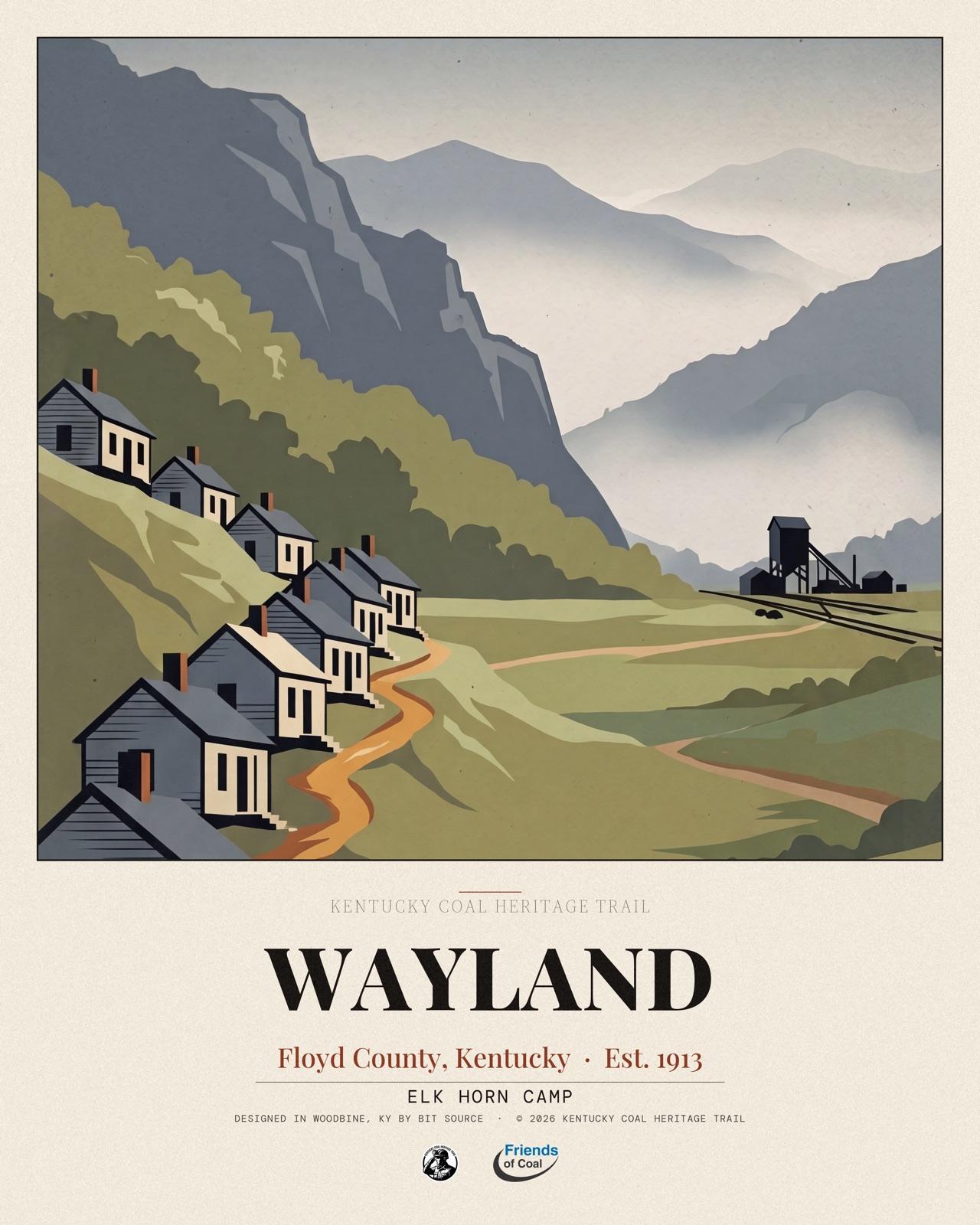
Wayland and the adjacent town of Garrett were both constructed to support the development of the #1 Elkhorn coal seam reserve that Elk Horn Coal had acquired in 1911. Mining commenced in 1914, and over the next 40 years of operation the underground mine workings extended to cover almost 15 square miles of tunnels inside the mountain. For the sake of comparison, downtown Manhattan in NYC is 22 square miles. During the life of the mine, the hard-working miners extracted over 40 million tons of coal for shipment on the C&O Railroad. During the mine's years of peak production, approximately 1200 miners worked in and around the mines, supporting all facets of the mine's operations. One of the many mine entrances has now been incorporated into the waterfall park on the south end of town on KY 7.
The Schools
The first school built in Wayland was a wooden building consisting of grades one through eight. This building eventually burned down and a new brick school was built in 1928. The upstairs of this building was the high school and the downstairs was the grade school. In 1941, a new high school was constructed, leaving the other building to be used as strictly a grade school. Wayland’s schools were considered the heartbeat of the community. The physical structure of a school held immense importance to the town and was a place for community events, sports, and education for several decades. Wayland High School closed in 1972, merging with Garrett, Martin and Maytown to form Allen Central High School. Allen Central was further consolidated into Floyd Central High School in 2018. The Gymnasium The Wayland Gym was constructed in 1937, utilizing a balloon framing exterior constructed around a steel I-Beam substructure. The gym was one of the prime social centers for the town, hosting numerous school and local events over the decades. Oftentimes the crowds attending the game were so large, they couldn’t fit into the gym, and locals frequently tell of times when the roar of the crowd outside of the gym reacting to news from the game exceeded the noise generated inside by the fans lucky enough to gain admission. Depot and the turntable When the land now constituting Wayland was bought, the only means of transportation of goods and minerals was either by flatboats on the creeks or over land in wagons. In 1911, agents of the Elkhorn and Beaver Railroad began to secure right-of-ways for the construction of a railway from Allen to Wayland. This photo shows the end of the rail line and the beginning of construction on a turntable on which to turn the large locomotives so they could return to the railyard in Allen. The Glo Spur consisted of approximately two total miles of track; the town of Glo itself once had a coal tipple, coal mine, company store, coal office, hotel, and more. The C&O would leave empty cars on the team track, where a local switcher would spot them under the tipple for loading and begin spotting pre-loaded cars on the team track. Meanwhile, the C&O locomotives would run light south to Wayland, KY, turn around at the turntable there, and head back to Glo. When they returned, they picked up the loaded cars on the team track and headed back to Martin, KY, where there was a 10-track yard. The Bank Wayland's first and only bank was located in the building currently occupied by the Post Office. The Bank of Wayland was established in February 1914 with an initial capitalization of $50,000, with a second location in Wheelwright. The bank operated for almost 20 years and held deposits of $255,000 prior to its closing. Both locations closed and never reopened when the bank filed for bankruptcy in 1931 due to the nationwide run on banks caused by the Great Depression. Post Office The post office was established May 18, 1914, with Louis Martin as postmaster. There are letters at the historical society that document WW Goldsmith’s attempts to establish the post office in Wayland in existing buildings. Elkhorn Coal Company Office The main office for Elkhorn Coal Company was located in the building currently housing Compassion Pediatrics. This building housed both the administrative and engineering staff for the mine. Community Center - Wayland Historical Society - Coal Room - Company Store Where the Wayland Community Center stands today was once the camp’s “company store.” Travel was limited from one camp to the next, and the roads were rough in between. Companies needed to feed and supply their workers, so each camp had a “company store.” Companies supplied their own form of payment called “script” which could only be spent at the company store. Many miners went into debt to the company stores themselves, as prices were set by the companies and often according to the miners' pay. The Community Center is now home to the Wayland Historical Society, which hosts a museum full of relics from Waylands past. One example is a recreation of the Wayland Fountain, a restaurant where folks gathered to socialize, as well the Denver Collier Coal Room, a collection of coal related artifacts. The original Jailhouse in Wayland still sits on the corner in town at the junction of KY 7 and KY1086.
Notable People
-King Kelly Coleman The gymnasium continues to hold great significance to Wayland because it was the home of King Kelly Coleman, who Adolph Rupp calls "the greatest high school player who ever lived.” There are threads that run through all coal communities - church, food, education, sports - but the sports thread is particularly special to Wayland. In Coleman’s four-year career at Wayland High School, he scored 4,263 points in 127 games, giving him a 33.6 per game mark in a time before the 3-point shot. He went on to later be drafted by the New York Knicks. The Mountain Sports Hall of Fame, now hosted in the historic gym, displays a variety of sports artifacts from across Appalachian Kentucky. George Evans-Secretary of the Kentucky Energy Cabinet-1987, President of National Mines Corporation, President of Evans Elkhorn Coal Corporation, Chairman of the United Way Advanced Gifts Campaign, Chairman of the Board of the Bank of Lexington Troy Mullins-city policeman 50 years Melvin Wicker-town doctor for 42 years “Copper” John Campbell-HOF Basketball coach 11 years Noah Howard-Company engineer 20 years Dave Tufts-Local Barber-(held keys to tennis courts and local favorite of the towns children) Phylis Honshull-educator and local historian Ray Patton-professional baseball player Important Events - 1923 Wayland is Incorporated 1947 Commissioner of Major League Baseball and future Kentucky Governor A.B. “Happy” Chandler threw out the first pitch to commemorate the first night baseball game in Wayland. 1959 Little League Baseball formed 1972 Wayland High School Closed 2022 July-Epic Flood